(This article first appeared in Arty 42 (Souvenirs) (winter edition 2019-20). For more info about the publication, see below.)
I grew up in Malta in the Seventies, returning to England in 1982 when my parents split up. Memories of my childhood there are a mix of sensations: unforgiving heat, the scent of lemon trees, the taste of salt from the sea, the intense colours of stained glass and religious paintings in Catholic churches, the bright light of candles burning at altars. Thirty-seven years later I returned with my daughter, wanting to revisit the old temples I remember climbing over as a child, see the Caravaggio masterpiece The Beheading of Saint John the Baptist (1608) and eat delicious cakes at Caffe Cordina in the walled city of Valletta.
I’d recently become intrigued by the Venus of Willendorf and the Venus figurines, of which there is one of note in Malta (the Venus of Malta, discovered in the Hagar Qim temples (3300 BC)). After also visiting The Sleeping Lady—a unique neolithic statuette thought to symbolise death (the eternal sleep) unearthed at the Hal Saflieni Hypogeum, I decided to explore further afield to Gozo —a sister island to Malta and one I have little recollection of visiting as a child.
The Ggantija temples of Gozo, built circa 3800-3000 BC, predate Stonehenge and the pyramids of Giza and are possibly the oldest surviving freestanding structures in the world. Various clay figurines have been discovered here—some evidently female in form, some androgynous or anthropomorphic. It is thought the statuettes may represent some form of worship of a cult of fertility, although this is open to debate. According to local folklore, a giantess who lived solely on broad beans and honey built the temples and used them as a place of worship.
Staring through the glass, one figurine in particular caught my eye. It was impossible not to be delighted by the simplicity of the features. An open, round face, much like that of my daughter, stares up to the sun. Huge, round buttocks and thighs suggest a female form, however there is no suggestion of breasts and the face is more childlike than adult. One hand touches the belly, hinting at satiety and physical contentment. The overall effect of the figure is one of joy and life affirmation.
I took a photo as a souvenir and, when I arrived home, I looked again at the face of the figurine and decided I had to paint it. What fascinates me, beyond its physicality which is of great beauty in itself, is the feeling that somehow it captures an essence of what it is to be human—and that this has translated over almost 6000 years. Through all the great historical, geographical, social and cultural changes of the centuries, the creator of this object has managed to distill and communicate something remarkable to us as a species, and something which is ultimately unchanging.
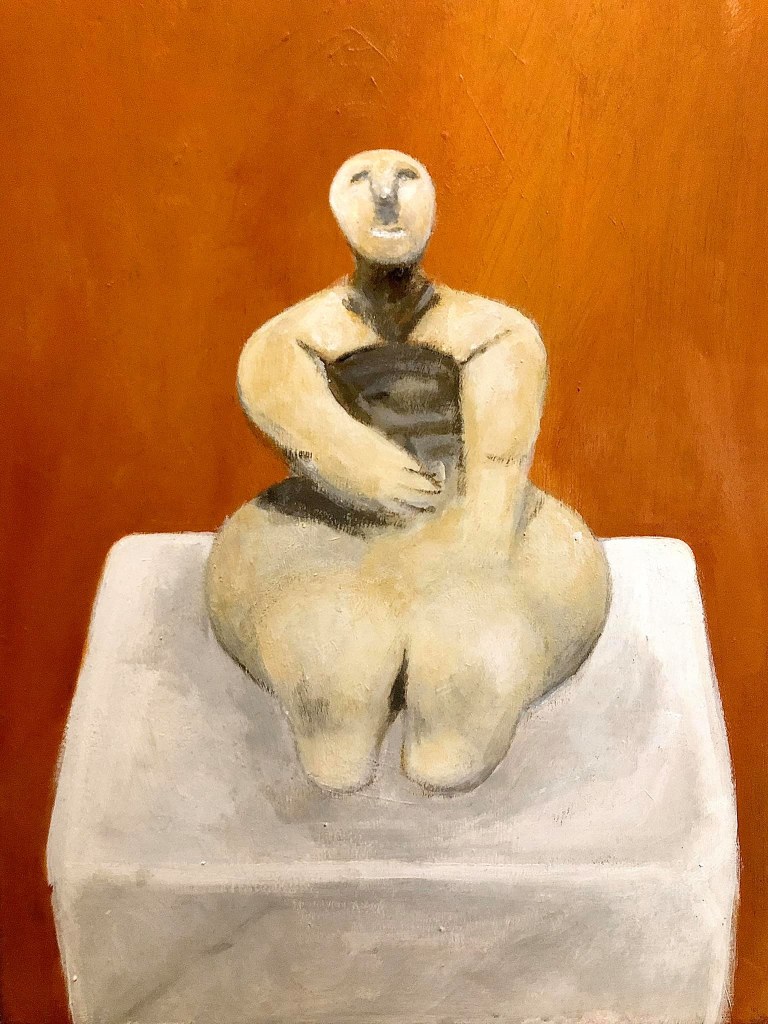
(40 x 30 cm, heavy body acrylic on canvas)
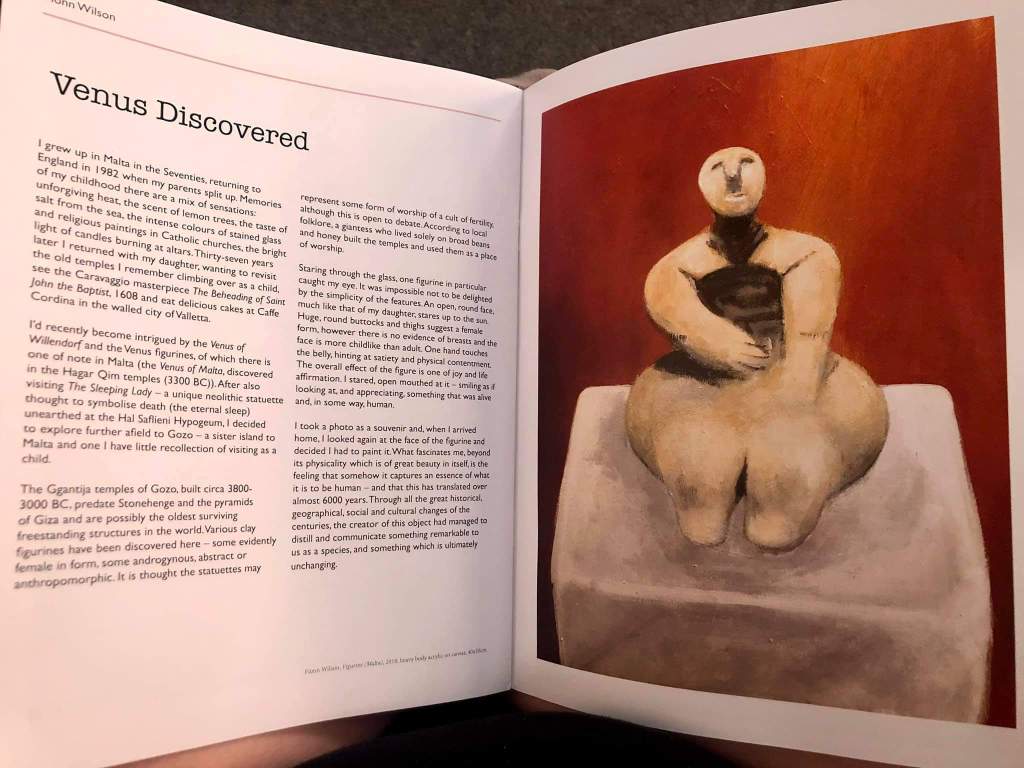
(winter edition 2019-20)
About Arty magazine:
“Frustrated by opportunities for emerging artists to voice their opinions and concerns and inspired by seminal punk zine Sniffin’ Glue, artist Cathy Lomax started Arty in April 2001. It was described by fellow artist Alex Michon as ‘an antidote to the kind of dry, critic-led writing about art which was becoming increasingly out of touch with the kind of work which was appearing in minuscule galleries throughout the land.’
From its first issue Arty has tracked the subjects that its creator Cathy Lomax is preoccupied by. In its 30+ issues to date Arty’s eclectic content has put subjects such as fame, romance, the Deep South, white, Rome and architecture under the spotlight. Made up of the drawings, photographs and words of over 40 (mainly artist) contributors, Arty doesn’t demand that they write like academics, art critics or journalists or even that they make finished artworks but simply that they explore subjects that they are interested in, in any way that works for them.”
See more at: https://artymagazine.com/
#painting #art #figurativeart #figurativepainting #malta #artymagazine #venus

 Fionn Wilson
Leave a comment