In the winter of 1882–1883 the German philosopher Friedrich Nietzsche wrote an enigmatic note in a private journal that has always fascinated me. “With firm shoulders,” it said, “space stands braced in opposition to nothingness. Where space is, there is being.”
For a painter, certainly, this makes sense. When doing a painting there is no such thing as an empty space, only differences in colours and light to be manipulated. Physicists now say that physically, so-called empty space has an amount of energy that can be calculated, and it’s 0.0000000001 joules per cubic metre. And so it’s not actually empty. I’m not confident, tho, that measurable energy is what Nietzsche meant by “being”, and also, I don’t think he was referring to outer space. I think he was talking about us humans in the sense that we are the products of space.
Usually people talk about us being the products of history, our own personal history as well as History spelled with a capital H. However, for Nietzsche, allowing oneself to be, or rather to become, a product of history, would be weakness. It would, using his famous expression, be resentment. The noble person, the singular person, is a product of space, not time. He or she dominates his or her space, his or her house, the domus, which is the origin of the term “domination”. He or she was born to do so and so in a sense borne from it, and he or she is one with it.
Quite obviously, very few people live like that, nor would anyone but psychopaths want to. Nietzsche wasn’t a genius because he was right but because he was wrong in spectacularly clever ways. Painters assert themselves by dominating the canvas, but otherwise they’re just as exiled in space as the rest of us. We might have been born from space, but if so, we were born as outcasts. This is what one sees in Fionn Wilson’s two self portraits: it’s the artist having captured herself in a space she can control, the space of the canvas, but as a person in a space which she can’t. This is what makes them emotionally captivating. In the one (Self portrait, summer (2024)) she is seen staring into the exact nothingness that space, according to Nietzsche, stands braced against, and in the other she is looking straight at us. When seen together, the implicit suggestion that we, as viewers, might also constitute some kind of void is unnerving. Self portrait (2021) is a particularly brilliant, psychological self portrait, done in a slightly naive, naturalistic fashion bordering on expressionism. Personally, I think it’s the best painting Fionn Wilson has done so far. The background against which she is seen is blurry or foggy. We do not know where she is, and from the look in her eyes, most likely she doesn’t know herself either. Whatever space this is, she’s not dominating it. Rather, she is lost in it. I find the tension between this sense of lostness and Wilson’s ability to control the canvas artistically very moving.
Bo Gorzelak Pedersen, 2024
Writer, artist and art critic
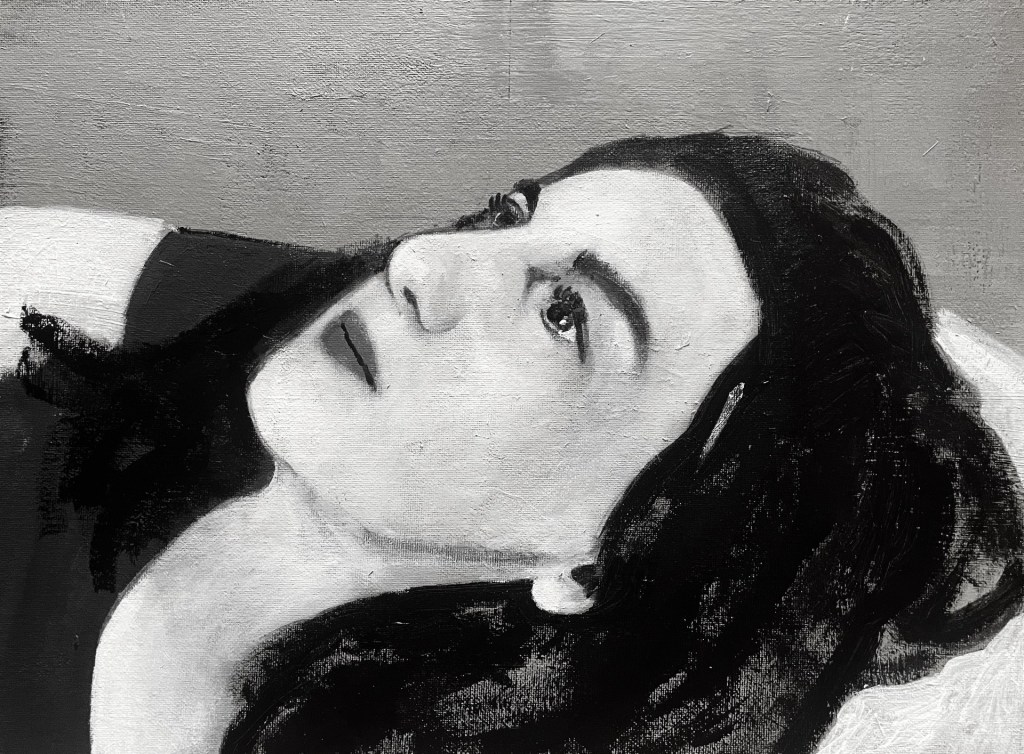
Self portrait, summer (2024)
(30 x 40 cm, heavy body acrylic on canvas)
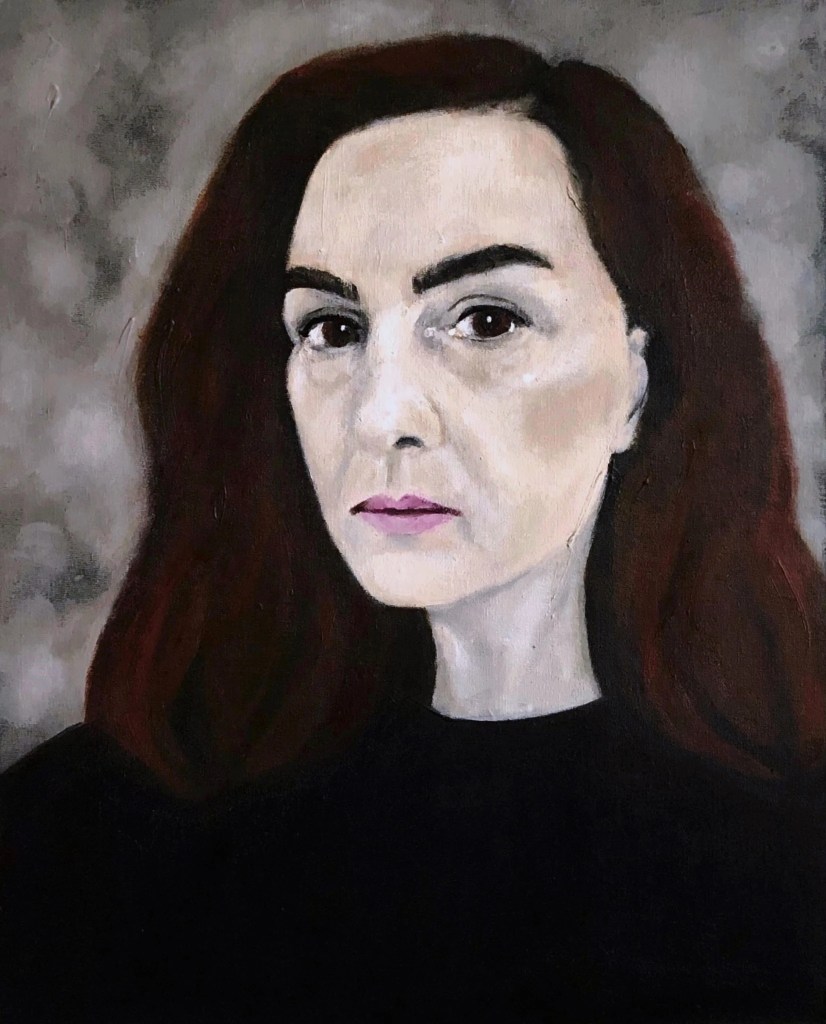
Self portrait, post psychosis (2021)
(50 x 40 cm, heavy body acrylic on canvas)
#painting #selfportrait #Nietzsche #art #philosophy
 Fionn Wilson
Leave a comment